
Health care trading network buys case support platform

Health care trading network buys case support platform

Global Healthcare Exchange Inc. bought Explorer Surgical Corp. on undisclosed terms. GHX is a Louisville-based software-as-a-service company. Explorer Surgical operates a digital and remote case support platform and is based in Chicago.

GHX’s main offering is GHX Exchange, which connects health care providers and suppliers of goods and services via electronic platform, a back-office supply-chain and purchasing system and incorporating data and analytics globally, according to its website, news reports and a press release on the acquisition.

Explorer Surgical’s work also includes connecting suppliers with health care providers, including remote mentoring and performance-tracking tools. One offering lets hospitals “guide, track and analyze activity in the operating room, and improve communication and performance,” startup journal Chicago Inno said.

“Patient care decisions must be grounded in data, product expertise and procedural best practices because lives depend on it,” GHX president and CEO Bruce Johnson said in a press release announcing the deal.

“Healthcare is rife with inefficiency and must standardize the operational and clinical best practices and products that yield the best possible patient outcomes,” Explorer Surgical co-founder and CEO Jennifer Fried said.

Explorer Surgical had raised $11 million in funding through April, led by Aphelion Capital in California and Sofia Fund, a Minnesota group investing in technology companies run by women, Chicago Inno said.

The acquisition of Explorer Surgical follows GHX’s purchase of Lumere, founded as Procured Health in 2014 and focused on cutting health care costs with data and analytics, in January 2020. In 2018 it bought Medical Columbus AG, a cloud-based health care supply-chain manager.

GHX was founded in 2000 by industry suppliers including Medtronic Inc., Abbott Laboratories, GE Healthcare, Johnson & Johnson and Baxter International. Other owners joined through February 2014 a healthcare journal said, reporting its sale to private equity firm Thoma Bravo LLC.

The private equity firm at the time generally invested up to $300 million in its acquisitions. Additional acquisitions followed its buyout.

In May 2017, Singapore-based Temasek Holdings Ltd. bought most of Thoma Bravo’s stake. Thoma Bravo exited its investment fully in June 2021 when Warburg Pincus made a minority investment in GHX. PE Hub said the Pincus investment was $500 million.

GHX works with 5,600 health care providers and 950 suppliers in the U.S. and Europe, its website said. In the Warburg investment press release, GHX said its platform serves providers with 80% of licensed hospital beds in the U.S. and that 85%

Read More

What Kind of Cosmetics are Good to Use?

What Kind of Cosmetics are Good to Use?

Nowadays, thanks to the growing popularity of Korean skin care methods, more and more women and men understand the importance of taking care of their skin and hair. Therefore, much more attention is paid to choosing the best cosmetics.  Soap or shampoo is not only supposed to wash, but also smell nice to nourish the skin or hair. That’s why the composition of cosmetics as well as the manner in which they are made are important. Onlybio cosmetics  meet the expectations of customers by offering cleaning products that contain natural ingredients and raw materials.

  1. What is only bio?
  2. Why should you use only eco cosmetics and cleaning products?

Let’s dive into the world of natural cosmetics and self care.

What is only bio?

Onlybio is an eco-friendly cosmetics manufacturer. The products it offers are made of 100 natural raw materials that come from organic certified crops. Only Bio knows that cosmetics do not have indirect skin contact, but direct contact. For this reason, there is no room for half-measures. All ingredients must be skin-friendly and have a positive effect on the skin. The goal of Only Bio is clean skin and hair as well as clean earth because they know that planet b doesn’t exist in case of destroying the earth. What is more, OnlyBio provides cosmetics for the whole family and is vegan friendly.

Why should you use only eco cosmetics and cleaning products?

Using natural, ecological cosmetics from organic certified crops is really important. First of all, nowadays taking care of the environment is needed. Second of all, natural cosmetics are usually better for hair or skin. Their actions are safer and healthier for the body and at the same time the products can smell amazingly. Although naturally derived ingredients can spoil, technology avoids such problems. A lot of those kinds of products also have hypoallergenic version. OnlyBio cosmetics come from certified crops and are made by ingredients with natural origin. What is more, with OnlyBio cosmetics natural cosmetics vegan can be really satisfied. Every product category created by this brand is crafted from the ground up with attention to detail and concern for the well-being of every customer.

Choosing the right cosmetics for your body and hair should be done with special care. Price is not the most important thing here, after all, it’s about looking beautiful and …

Read More

The Ultimate Guide to Strength Training for Travellers

While travelling, you wouldn’t want your body to become weak. You want to keep fit and maintain your body shape for as long as you can. There are different training programs for you.

From opinions shared on UK.collected.reviews, travellers are always thrilled to find workout places while on a trip. This is why many vacation destinations have been equipped with gyms and equipment that facilitate physical health.

To enjoy the best vacation experiences, you can consider these are the best guide to strength training while on a trip:

·       Locate a Local Gym:

Don’t raise your eyebrows yet. Of course, you don’t need to walk into a gym to exercise yourself every time. However, the gym has most of all you need for your workouts. If you plan well, you’ll look for destinations that have the best gym and fitness centre for your workouts. It will be best if you find a hotel with a gym inside it. Even a swimming pool. It will be the best location for your fitness vacation in the UK. If there are no hotels in the areas you want with a gym, find a local gym and join them.

·       Request for and Purchase a Card for YMCA Gyms:

 This is a program of monthly subscription for different exercising programs anywhere in the world. You’ll get to access different exercise programs, locate the best wellness pools and centres, and also stay fit while enjoying your trip.

·       Find a Local Park and Exercise:

If you can’t get a local gym or afford a date with the YMCA gym guys, you can easily find yourself a park where you can train. You can engage in a different workout at the park. All you need to do is to dress well and dress fit. You should also have some travel-friendly workout equipment with you. If you like music, go with your music Bluetooth speaker. All you need to do is to create a small space for yourself and do your thing. You can start with the skipping rope, suspension trainer, yoga, and many others.

·       Check Online:

There are always tons of blogs and YouTube vlogs that are dedicated to simple and explosive training. You can follow a few online blogs to know what they do and also engage in their routine physical exercise plans. You may also need to figure out the …

Read More

Age discrimination: Seniors say they feel devalued when interacting with health care providers

Age discrimination: Seniors say they feel devalued when interacting with health care providers

There was the time several years ago when she told an emergency room doctor that the antibiotic he wanted to prescribe wouldn’t counteract the kind of urinary tract infection she had.

He wouldn’t listen, even when she mentioned her professional credentials. She asked to see someone else, to no avail. “I was ignored and finally I gave up,” said Whitney, who has survived lung cancer and cancer of the urethra and depends on a special catheter to drain urine from her bladder. (An outpatient renal service later changed the prescription.)

Then, earlier this year, Whitney landed in the same emergency room, screaming in pain, with another urinary tract infection and a severe anal fissure. When she asked for Dilaudid, a powerful narcotic that had helped her before, a young physician told her, “We don’t give out opioids to people who seek them. Let’s just see what Tylenol does.”

Whitney said her pain continued unabated for eight hours.

“I think the fact I was a woman of 84, alone, was important. When older people come in like that, they don’t get the same level of commitment to do something to rectify the situation. It’s like ‘Oh, here’s an old person with pain. Well, that happens a lot to older people,'” she said.

Whitney’s experiences speak to ageism in health care settings, a long-standing problem that’s getting new attention during the Covid-19 pandemic, which has killed more than half a million Americans age 65 and older.

More organ transplant centers require patients to get Covid-19 vaccine, or get bumped down waitlist

Ageism occurs when people face stereotypes, prejudice or discrimination because of their age. The assumption that all older people are frail and helpless is a common, incorrect stereotype. Prejudice can consist of feelings such as “older people are unpleasant and difficult to deal with.” Discrimination is evident when older adults’ needs aren’t recognized and respected or when they’re treated less favorably than younger people.

In health care settings, ageism can be explicit. An example: plans for rationing medical care (“crisis standards of care”) that specify treating younger adults before older adults. Embedded in these standards, now being implemented by hospitals in Idaho and parts of Alaska and Montana, is a value judgment: Young peoples’ lives are worth more because they presumably have more years left to live.

Justice in Aging, a legal advocacy group, filed a civil rights complaint with the U.S. Department of Health and Human Services in September, charging that Idaho’s crisis standards
Read More

Current health care system cannot survive aging population

Current health care system cannot survive aging population

The anticipated rise in healthcare costs due to the aging population is simply not sustainable.

The U.S. has the second largest oldest population in the world. By 2050, 21.4 percent of our population will be 65 years or older. Heart disease and stroke are the leading causes of death in the U.S. population accounting for one-third of the deaths in the U.S. every year. The cost is staggering, with direct costs of 214 billion dollars and a further cost of 138 billion dollars due to lost job productivity.

Cancer is the second leading cause of death in the U.S., costing the healthcare system of approximately 174 billion dollars. Diabetes, obesity and Alzheimer’s disease are endemic and will continue to rise with an aging population. The anticipated rise in healthcare costs due to the aging population is simply not sustainable.

A new approach to care delivery is required. We’re saddled with expensive, inefficient healthcare IT (HIT) that has severed the personal connection between doctors and patients as well as between nurses and patients. If we don’t change how care is delivered in this country, the healthcare system will collapse into a sea of red ink.

The move to value-based care is sometimes cited as a way to prepare for an aging population. But value-based models depend on enough patient volume to make the model work. Doctors and nurses are stressed enough due to inefficient HIT like EHRs, which were designed as billing systems that don’t accommodate healthcare workflows. HIT needs to make the transition from data collection to supporting higher levels of productivity.

Appropriate strategies to decrease the incidence of chronic diseases and the associated costs to the healthcare system are critical if all Americans are to have appropriate access to healthcare. Even a decrease of chronic diseases by 10 percent would result in savings of greater than 100 billion dollars to the health care system. Using primary and secondary prevention strategies that rely upon lifestyle changes are extremely cost-effective and will improve the quality of life for the aging population. Inparticular, improved education to the at-risk population will further enhance the positive impact to cost upon the health care system.

The 21st Century Cures Act mandates that patients have unfettered access to their medical records.Navigating through the maze of lab and imaging reports and physician notes with current technology is a daunting task for patients. We need to provide an

Read More

Short home workouts can boost your mood and reduce stress : Shots

Short home workouts can boost your mood and reduce stress : Shots

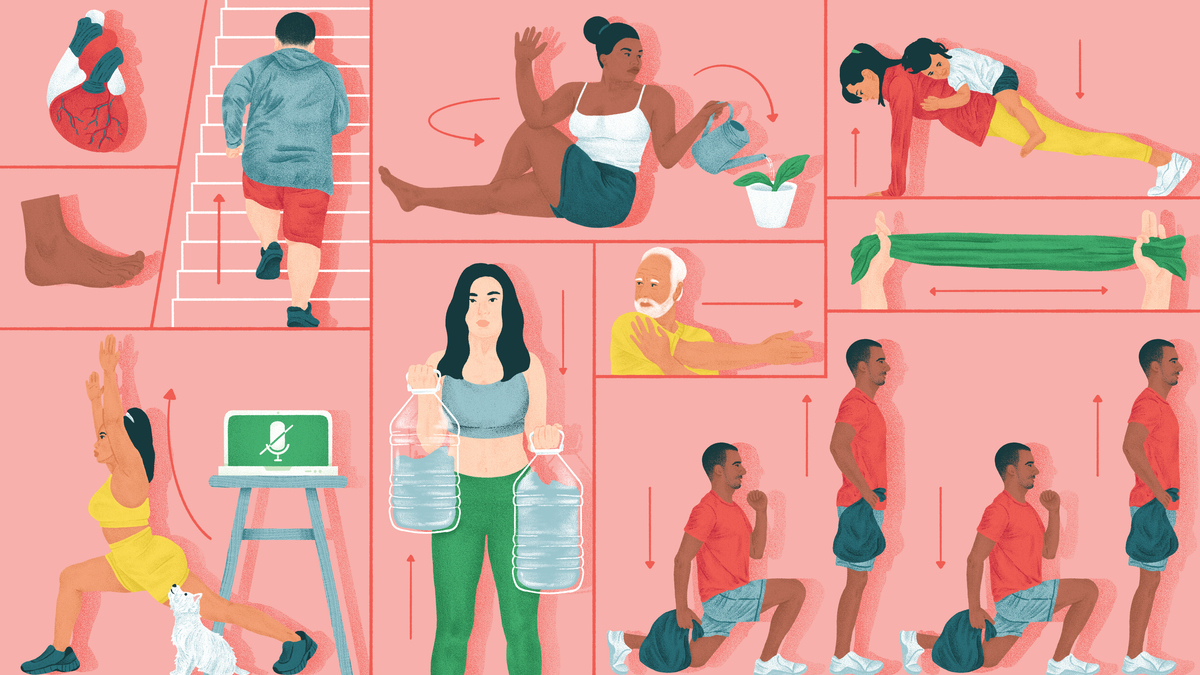
Add five-minute stints of fun and easy exercise to your day at home by working with what’s around you, says trainer Molly McDonald.

Cha Pornea for NPR


hide caption

toggle caption

Cha Pornea for NPR


Add five-minute stints of fun and easy exercise to your day at home by working with what’s around you, says trainer Molly McDonald.

Cha Pornea for NPR

Of all the ways in which the pandemic has affected Americans’ well-being, perhaps the one we’ve noticed least is how much we’re sitting. And it’s not just bad for our waistlines — it’s hurting our mental health.

More than a year and a half of social distancing and work-from-home policies have led to less time moving around and more time sitting and looking at screens — it’s a potentially toxic combination that’s linked with poorer mental health.

“The sneaky effects of the pandemic that we might not even notice [is] that we’ve changed our sitting patterns,” says Jacob Meyer, director of the Wellbeing and Exercise lab at Iowa State University.

His own research showed that in the early weeks of the pandemic, people who exercised less and had more screen time were likely to be stressed, depressed and lonely.

And though most people saw their mental health gradually improve as they adapted to a new reality, people who stayed mostly sedentary didn’t see get the same improvement, according to a follow-up study by Meyer. “People who continued to have really high levels of sitting, their depression didn’t improve” as much, says Meyer.

The good news is that something as simple as some very light movement around the house to break up all that couch surfing time can make a difference in mood, as Meyer’s earlier research has found.

Scores of previous studies confirm that being physically active boosts mood, lowers anxiety and improves sleep quality.

“We know consistently that the more people are active, the more that they exercise, the better their mental health is,” says Meyer.

For many office workers like me, working from home means we’ve fallen into a routine of spending hours at our desk. With another pandemic winter about to hit us and much of the country and the world still dealing with COVID-19, we are often stuck at home more than we’d like, so it’s time to start sitting less and moving around more.

Meyer and other exercise experts shared some tips

Read More