

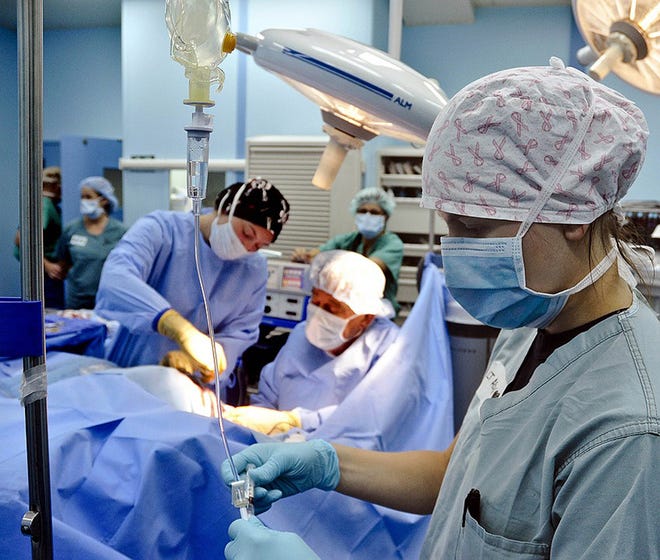
Labor shortage being felt at hospitals, healthcare systems

Labor shortage being felt at hospitals, healthcare systems

Almost every industry across the state over the past 18 months has been affected by a labor shortage.

Included in the labor shortage situation are health care staff, who are needed now more than ever as daily COVID-19 infections continue to surge across the state and in Northern Michigan.

Dr. Christine Nefcy, chief medical officer with Munson Healthcare, said Munson Healthcare — like many health care systems across the State of Michigan — is suffering from staffing issues for a variety of reasons.

Munson Healthcare, like other Michigan health systems including Ascension, Beaumont, Bronson, Henry Ford, Spectrum and University of Michigan, announced last month policies for staff to require COVID-19 vaccinations.

Munson Healthcare officials said the decision is a proactive move in anticipation of a federal requirement.

Specific details regarding a plan to require vaccinations for any business which employs 100 or more workers have not been released yet, but are expected to come soon.

John Karasinski, communications director for the MichiganHealth and Hospital Association, said it still remains to be seen what the actual policy details will be.

“However, our biggest concern is the potential impact on staffing,” Karasinski said. “While it creates a national standard for healthcare providers and facilities, it could result in employees in non-clinical positions leaving hospitals for other industries and smaller workplaces not impacted by the employer mandate.”

Other systems including McLaren have yet to make the COVID shot mandatory, but rather strongly encourage all employees to get vaccinated.

“Everybody is quite busy with non-COVID related issues as well as COVID, so all of (health care systems) are seeing the same thing,” Nefcy said. “What we have noticed here in Northern Michigan is our ability to transfer some of our sickest patients out of the system to other entities which would have traditionally taken them is taking much longer.

Christine Nefcy

“We are having much longer waits in our emergency departments for people who need to be hospitalized,” Nefcy added. “The pressure is really everywhere across the state and our ICU beds continue to increase in occupancy.” 

A story published recently in Bridge Michigan mentioned emergency department visits are up 43% in the last year in Michigan.

Additionally, studies have repeatedly shown emergency department overcrowding increases the risk of a patient to get sicker, or even die.

“Across our system we often see single digits in terms of critical care beds we have available and we

Read More

Health care industry pressures spurring strikes across the country | Local News

Health care industry pressures spurring strikes across the country | Local News

The strike at Mercy Hospital is more than two weeks old.

But it isn’t the only place in the country where health care workers have gone on strike or reached the brink of walking off the job.


'We definitely do have leverage,' Mercy Hospital nurses say amid strike, labor shortage

The ongoing worker shortage could provide leverage for CWA as they continue to negotiate with Catholic Health System, hospital employees and labor experts say.

The reasons health care workers cite for striking are similar: They have endured the demands and exhaustion of working through the pandemic and insist hospitals staff up to help shoulder the workload.

They say their complaints about staffing levels and working conditions preceded the pandemic but have moved to the forefront over the past year and a half with greater attention on their work.

The strikes and threatened walkouts are creating more urgency to confront the issues, at a time when hospital systems say they are struggling to recruit workers.


AG claims staffing firm in Mercy Hospital strike lacks license

The state Attorney General’s Office called for Huffmaster to stop providing its services to Mercy Hospital.

The swirl of worker shortages, the pandemic and the pressures health care workers are under have led some labor disputes to spill over into strikes, said Larry Zielinski, a former Buffalo General Hospital president.

“It just exacerbates the normal labor-management issues that have existed in health care for a long, long time,” said Zielinski, an executive in residence for health care administration at the University at Buffalo School of Management.


Mercy Hospital strike

Workers have been on strike at Mercy Hospital since Oct. 1.


It comes at a time when employers across the country, in all sorts of industries, are struggling to fill jobs, a dynamic that gives workers some leverage by making it harder for companies to hire replacements for striking workers.

The competition for workers also is forcing some industries to raise wages for lower-paid workers – a factor that has taken on a prominent role in the health care labor disputes, including at Mercy.

As the strike at Mercy continues, Catholic Health faces another pressure point, in the form of the millions of dollars it is paying each week to a staffing firm for temporary replacement workers it is relying upon to keep the hospital open.

As about 2,000 striking CWA members support their union’s push for a new contract, they are about to receive a financial boost.

More than 2,000 workers are part

Read More

‘Big & Bold’ demonstrates that while fitness is for all, it’s not one-size-fits-all

‘Big & Bold’ demonstrates that while fitness is for all, it’s not one-size-fits-all

On Nutrition

Let’s face it: Most people exercise with the hope it will help them lose weight, prevent weight gain or otherwise control the size and shape of their body. Sure, being healthy and feeling fit may also be goals, but the main motivator is often weight.

I once had a client tell me she took an intense fitness boot camp class for six weeks and didn’t lose any weight, so she didn’t see any point in exercising. Another client told me that once she learned that science says exercise does little for weight loss (which is true), she decided there was no reason to try to fit walking into her busy schedule.

That’s unfortunate, because there are so many reasons to move our bodies that have nothing to do with weight loss. For example, a study published last month concluded that physical activity promotes health more effectively than weight loss — with the added benefit of reducing the health risks associated with yo-yo dieting.

The persistent coupling of exercise to the idea of weight loss has also created a narrow view of what exercising bodies look like. If you’re not in a thin body, but you only see thin bodies in fitness books and magazines, in ads for gyms and yoga studios, and embodied in personal trainers and class instructors, what does this suggest? It suggests that exercise will make you thin, too — which can kill motivation when it doesn’t — or that your body has no business being in the gym or yoga studio.

One woman working to offer a more inclusive view of fitness is certified personal trainer Morit Summers, co-owner of Form Fitness, a gym in Brooklyn, New York, and author of the new book, “Big & Bold: Strength Training for the Plus-Size Woman.” The book is both serious and supportive, with clear, detailed instructions on how to perform movements safely and effectively, plus advice for how to lift in a way that fits your life and helps you reach your strength goals. While the book provides beginner-through-advanced starter workouts, Summers encourages listening to your body and modifying movements as needed. For such a meticulous and thoughtful book, its origins were … unplanned.

“I was asked if I wanted to write the book by the publishing company [Human Kinetics]. I was like, ‘Whoa, what?’ Because that was never something on my bucket

Read More

Majority (55.5 percent) were equally worried about the privacy of medical records, DNA data, and facial images collected for precision health research — ScienceDaily

Majority (55.5 percent) were equally worried about the privacy of medical records, DNA data, and facial images collected for precision health research — ScienceDaily

Uses of facial images and facial recognition technologies — to unlock a phone or in airport security — are becoming increasingly common in everyday life. But how do people feel about using such data in healthcare and biomedical research?

Through surveying over 4,000 US adults, researchers found that a significant proportion of respondents considered the use of facial image data in healthcare across eight varying scenarios as unacceptable (15-25 percent). Taken with those that responded as unsure of whether the uses were acceptable, roughly 30-50 percent of respondents indicated some degree of concern for uses of facial recognition technologies in healthcare scenarios. Whereas using facial image data in some cases — such as to avoid medical errors, for diagnosis and screening, or for security — was acceptable to the majority, more than half of respondents did not accept or were uncertain about healthcare providers using this data to monitor patients’ emotions or symptoms, or for health research.

In the biomedical research setting, most respondents were equally worried about the use of medical records, DNA data and facial image data in a study.

While respondents were a diverse group in terms of age, geographic region, gender, racial and ethnic background, educational attainment, household income, and political views, their perspectives on these issues did not differ by demographics. Findings were published in the journal PLOS ONE.

“Our results show that a large segment of the public perceives a potential privacy threat when it comes to using facial image data in healthcare,” said lead author Sara Katsanis, who heads the Genetics and Justice Laboratory at Ann & Robert H. Lurie Children’s Hospital of Chicago and is a Research Assistant Professor of Pediatrics at Northwestern University Feinberg School of Medicine. “To ensure public trust, we need to consider greater protections for personal information in healthcare settings, whether it relates to medical records, DNA data, or facial images. As facial recognition technologies become more common, we need to be prepared to explain how patient and participant data will be kept confidential and secure.”

Senior author Jennifer K. Wagner, Assistant Professor of Law, Policy and Engineering in Penn State’s School of Engineering Design, Technology, and Professional Programs adds: “Our study offers an important opportunity for those pursuing possible use of facial analytics in healthcare settings and biomedical research to think about human-centeredness in a more meaningful way. The research that we are doing hopefully will

Read More

What led to Bill Clinton’s hospitalization? Warning signs of the common infection

What led to Bill Clinton’s hospitalization? Warning signs of the common infection

The urologic infection that a source close to Bill Clinton says led to the former president’s hospitalization is common in older individuals and can be serious, experts say.

But when treated in a timely manner, the prognosis for such cases is excellent.

Clinton, 75, was admitted Tuesday evening to a California hospital, where he received intravenous antibiotics and fluids, his doctors said in a statement, adding that Clinton was responding well to treatment.

Former President Bill Clinton hospitalized with infection

A source close to Clinton told NBC News that his initial diagnosis was a urologic infection that morphed into a broader infection.

While little else was immediately revealed about Clinton’s condition, including whether it originated in his urinary tract or elsewhere in the urinary system, experts who were not involved in his care said such spread of infection can be life-threatening without prompt medical attention.

“This is not uncommon. This is something we frequently treat in the emergency room, where somebody comes in with a urinary tract infection,” NBC News senior medical correspondent Dr. John Torres said Friday on the “TODAY” show. “Especially as they get older, their body is not able to contain that, so it moves from the urinary tract, from the bladder and the kidneys, into the bloodstream.”

At that point, Torres said, a patient is at risk of sepsis — a dangerous overdrive of the immune system in response to an infection — or septic shock, when organs start to fail.

Doctors must keep a close eye on these patients to make sure the strong antibiotics they are treating them with are lowering their white blood cell counts, which would indicate the infection is getting under control, said Dr. Ash Tewari, a urologist and prostate cancer specialist at Mount Sinai in New York.

Doctors will also work to identify any underlying conditions that may have led to the infection in the first place: a blockage, a kidney stone, even diabetes, Tewari said. Sometimes, procedures are necessary to prevent future recurrences.

While urinary tract infections are common in young women, in young men, they are exceptionally rare. Later in life, men become more prone to them, the experts said, because the likelihood of developing an enlarged prostate increases with age — and that can interfere with the bladder’s ability to fully empty.

“If you have difficulty with urinary symptoms with voiding, that can put you at increased

Read More

The Transformation of the Fitness Industry

The Transformation of the Fitness Industry

This article is part of our Business Transformation special report, about how the pandemic has changed how the world does business.


Like restaurants, retailers and other businesses normally conducted in crowded locations open to the public, the health and fitness industry in Europe is scrambling to recover and get its business back on track — as soon as it figures out what its business will look like.

The orders by public health authorities to close health and fitness clubs several times have had a profound effect on the industry. The consulting firm Deloitte estimates that clubs in Europe lost 15.4 percent of their members, or more than 10 million people, even when closures were relatively brief. Industry revenue fell twice as much, by almost 33 percent, as clients froze their accounts or requested refunds.

While the pandemic drags on, club executives are trying to fully understand how fundamentally Covid-19 has transformed their industry, which generated $96.7 billion in global revenue in 2019.

“For a long time now, I believe that too many health club leaders around the world assume they have the full and undivided attention of the exercising consumer,” said Ray Algar, a global fitness industry business adviser and analyst with Oxygen Consulting in Brighton, England. “That the gym sits at the top of some exercise industry hierarchy.”

“The gym may have once had this temporary monopoly, but this is over, and the pandemic has demonstrated that consumers can capably locate and enjoy many different gym substitutes,” he said. “What the pandemic has done has made these gym substitutes more visible. So, this does represent a significant inflection point because never has this global industry been challenged to demonstrate its right to serve and support the exercising consumer.”

Stefan Ludwig, a Deloitte partner and leader of the Sports Business Group, said that the lockdowns had indeed had a “significant impact on both consumer behavior and operator offerings.”

A report by ClubIntel, a marketing research and consulting firm, found that closed clubs led many people to lose the habit of exercising regularly and caused others to try alternatives, such as biking, joining a walking club, signing up for video classes (dance and boxing are popular options) or buying an interactive device like a Peloton or Mirror.

Many customers, the report found, have chosen remote options offered by providers other than a fitness club. To retain or recoup prepandemic clientele, clubs

Read More