WHO and partners call for action to better protect health and care workers from COVID-19

WHO and partners call for action to better protect health and care workers from COVID-19

The World Health Organization and partners[i] have issued an urgent call for concrete action to better protect health and care workers worldwide from COVID-19 and other health issues. 

The organizations are concerned that large numbers of health and care workers have died from COVID-19, but also that an increasing proportion of the workforce are suffering from burnout, stress, anxiety and fatigue.

In a Joint Statement issued this week, WHO and partners are calling
on all Member State governments and stakeholders to strengthen the monitoring and reporting of COVID-19 infections, ill-health and deaths among health and care workers. They should also include disaggregation by age, gender and occupation as a standard
procedure, to enable decision makers and scientists to identify and implement mitigation measures that will further reduce the risk of infections and ill-health.

The Statement also urges political leaders and policy makers to do all within their power to make regulatory, policy and investment decisions that ensure the protection of health and care workers. It highlights the opportunity to align this with a forthcoming
global health and care worker compact and the International Labour Organization’s call for a human-centered recovery from the COVID-19 crisis.

Finally, the partners call upon leaders and policy makers to ensure equitable access to vaccines so that health and care workers are prioritized in the uptake of COVID-19 vaccinations. Available data from 119 countries suggest that by September 2021,
2 in 5 health and care workers were fully vaccinated on average, with considerable difference across regions and economic groupings. Less than 1 in 10 have been fully vaccinated in the African region while 22 mostly high-income
countries reported that above 80% of their health and care workers are fully vaccinated. These rates only account for data reported to WHO through the standard mechanisms.

We have a moral obligation to protect all health and care workers, ensure their rights and provide them with decent work in a safe and enabling practice environment. This must include access to vaccines”, said Jim Campbell, Director
of the WHO Health Workforce Department. “Beyond vaccines , economic recovery  and all new investments in emergency preparedness and response must prioritize  the education and employment of health and care workers, linking to the UN  Secretary-General’s
Global Accelerator for Jobs and Social Protection,” he added.

A new WHO working paper estimates
that between 80 000 to 180 000 health
Read More

Medicaid expands funding for home and community-based care : Shots

Medicaid expands funding for home and community-based care : Shots

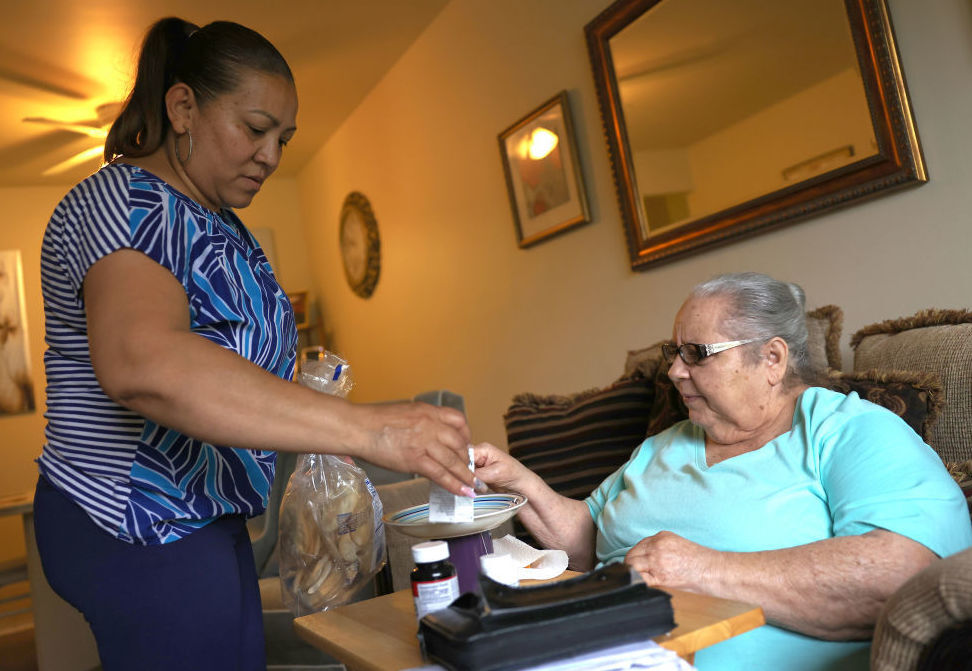
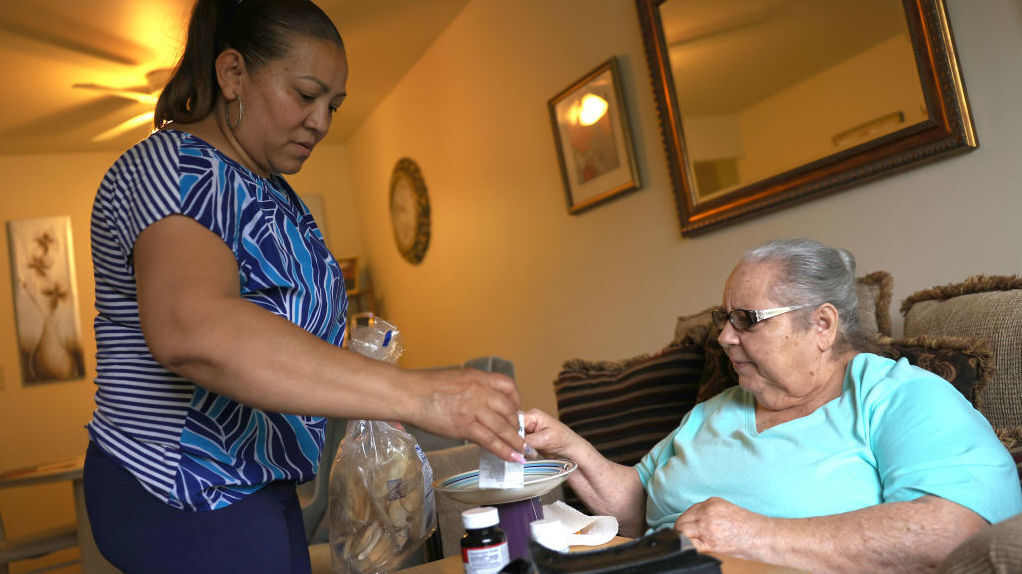
Expanded funds for in-home care can help seniors and disabled Americans stay in their homes. Here, Lidia Vilorio, a home health aide, gives her patient Martina Negron her medicine and crackers for her tea in May in Haverstraw, N.Y.

Michael M. Santiago/Getty Images


hide caption

toggle caption

Michael M. Santiago/Getty Images


Expanded funds for in-home care can help seniors and disabled Americans stay in their homes. Here, Lidia Vilorio, a home health aide, gives her patient Martina Negron her medicine and crackers for her tea in May in Haverstraw, N.Y.

Michael M. Santiago/Getty Images

For older people and people with disabilities, solving everyday practical problems can be the difference between being able to live at home or being forced to move to an institution. Sometimes people need help getting dressed or making meals. Sometimes they need help managing medications or shopping for groceries.

Originally, these things weren’t paid for by Medicaid, the federal health care program that many low-income and disabled Americans rely on. In recent years, the program has worked to expand coverage of home-based care but it’s still optional for states. Some states have adopted it widely, while in others, more care still happens in nursing homes and other institutions.

In April, the Biden administration rolled out funding from the American Rescue Plan to help states boost these services. And Thursday, the federal Department of Health and Human Services unveiled every state’s plan for how they’ll use the funds. An estimated $12.7 billion dollars in federal matching funds are available to “encourage states to expand home and community-based services and strengthen their programs,” according to an agency press release.

“More and more people are saying, if I need care, I’d like it to be done at home or here in my community versus an institution or a hospital or a nursing home,” says Health Secretary Xavier Becerra. “In the 21st century, we’re moving closer to a care model that’s based on giving people services in their home.”

Becerra adds that his own father spent his last few months in hospice at home. “When he passed, he was in my home, he was surrounded by family,” he says.

Medicaid recently surpassed 80 million beneficiaries — the most ever since the program was created in the 1960s. It is the primary provider of long-term care services for older people, since these are not covered by Medicare or private insurance.

Read More

Montana Tribes Want to Stop Jailing People for Suicide Attempts but Lack a Safer Alternative | Healthiest Communities Health News

Montana Tribes Want to Stop Jailing People for Suicide Attempts but Lack a Safer Alternative | Healthiest Communities Health News

POPLAR, Mont. — When Maria Vega was a senior in high school in 2015, she found the body of one of her closest friends, who had died by suicide. A few days later, devastated by the loss, Vega tried to take her own life.

After the attempt failed, she was arrested and taken to juvenile detention in Poplar, a remote town on the Missouri River a short drive from the North Dakota oil fields. She was put in a cell and kept under observation for several days until a mental health specialist was available to see her. Her only interaction was with the woman who brought food to her cell.

“I remember asking her if I could have a hug and she told me, ‘I’m sorry, I can’t do that,’” Vega recalled. “That was honestly one of the hardest things I ever went through in my life. I felt like I was being punished for being sad.”

Jailing people because of a mental health issue is illegal in Montana and every other state except New Hampshire. But Vega is a member of the Fort Peck Assiniboine and Sioux Tribes, a sovereign nation with its own laws. An 11-year-old tribal policy allows law enforcement to put members who threaten or attempt suicide in jail or juvenile detention to prevent another attempt.

Maria Vega, a member of Montana’s Fort Peck Assiniboine and Sioux Tribes, was jailed in 2015 after a suicide attempt. Vega is now part of a group of tribal members, academics and policy experts proposing alternatives to the policy of jailing people who try to kill themselves. The policy was created in 2010 because of a lack of mental health resources on the reservation. (Sara Reardon for KHN)

Maria Vega, a member of Montana’s Fort Peck Assiniboine and Sioux Tribes, was jailed in 2015 after a suicide attempt. Vega is now part of a group of tribal members, academics and policy experts proposing alternatives to the policy of jailing people who try to kill themselves. The policy was created in 2010 because of a lack of mental health resources on the reservation. (Sara Reardon/KHN)

Fort Peck’s tribal leaders say they approved the policy out of necessity because there were no mental health facilities equipped for short-term housing of people in mental crisis.

The COVID pandemic has only exacerbated the crisis. In 2020, the tribes filed a record 62 aggravated disorderly conduct charges, the criminal charge they created in 2010 to allow law enforcement to book people they deemed a risk to themselves or others.

Stacie FourStar, chief judge of the Fort Peck Tribal Court, said this year has been even worse: The tribe is filing two to four charges per week. The policy has swept up people — particularly adolescents — with no criminal records and no experience

Read More

Deadly bacteria found in aromatherapy product sold at Walmart

Deadly bacteria found in aromatherapy product sold at Walmart

An aromatherapy room spray sold at Walmart may be linked to four cases of a highly uncommon bacterial infection that’s rarely seen in the United States.

The cases, diagnosed this year, were identified in Georgia, Kansas, Minnesota and Texas. Two of the people, including a child, have died.

On Friday, the Consumer Product Safety Commission announced that Walmart, which sold the product, “Better Homes & Gardens Lavender & Chamomile Essential Oil Infused Aromatherapy Room Spray with Gemstone,” is recalling nearly 4,000 bottles.

Better Homes and Gardens Essential Oil Infused Aromatherapy Room Spray with Gemstones.CPSC

That product, discovered in the home in one of the four patients, was found to be contaminated with potentially deadly bacteria called Burkholderia pseudomallei.

Federal health officials are now testing products found in the homes of the other three patients.

Patty Davis, a CPSC spokesperson, said the agency is extremely concerned about the potential for further, potentially dangerous, bacterial exposure.

“CPSC immediately reached out to Walmart to work with the company to get this product out of consumers hands,” Davis said. “We want to prevent anyone else from being sickened or from dying.”

Burkholderia pseudomallei bacteria are usually never found in household products, at least in the U.S.

Such bacteria are most commonly found in contaminated water or soil in southeast Asia or northern Australia. On average, about a dozen cases tend to be diagnosed in the U.S. each year, usually among people who had traveled overseas.

But four cases in a matter of months in 2021, particularly those who never traveled outside of the country, caught the attention of the Centers for Disease Control and Prevention.

When investigators took water and soil samples from each of the patients’ homes, they turned up nothing.

That’s when the team refocused the search for the source to imported products used inside the home, eventually identifying the bacteria in the aromatherapy spray in the Georgia patient’s home on October 6.

The CDC investigators established that the other patients also owned the aromatherapy spray, and now the agency is testing those products to see if the genetic fingerprint of the bacteria matches.

The bacteria were found in the lavender and chamomile version of the spray, but the CPSC and Walmart are also recalling five other scents in the same product line. The product was sold at about 55 Walmart stores and on Walmart’s website, according to the CPSC.

A

Read More

Oak Street Health buys virtual specialty care company RubiconMD for up to $190M

Oak Street Health buys virtual specialty care company RubiconMD for up to 0M

Oak Street Health, a chain of primary care clinics geared toward the Medicare population, has acquired virtual specialty care provider RubiconMD for up to $190 million.

The deal includes a base $130 million in cash with up to $60 million added subject to performance, paid either in cash or a cash and stock combination, according to an investor presentation.

RubiconMD provides a network of specialists providing care in areas including cardiology, nephrology and pulmonology. 

“Carlos Reines and I founded RubiconMD to democratize medical expertise so that primary care providers can offer all patients the care they deserve, and we are thrilled for this next step with Oak Street Health,” Gil Addo, cofounder and CEO of RubiconMD, said in a statement. “We share similar cultures and values, as well as a commitment to delivering high-quality patient care and lowering costs, and we look forward to continuing to innovate together.”

WHY IT MATTERS

Some patients face difficulties accessing specialty care, particularly those who are low-income or live in rural areasOak Street Health is positioning its purchase as a way to deliver specialty care more easily, with a better experience for patients, improved care coordination and lower costs.

“Oak Street Health is on a mission to rebuild healthcare as it should be, which we are doing by focusing on preventive care and driving more resources into the primary care setting,” Mike Pykosz, CEO of Oak Street Health, said in a statement.

“Like traditional primary care, specialty care is broken for older adults, but together with RubiconMD, we can rebuild it into a model that meets patient needs. Integrating and virtualizing specialty care into Oak Street Health’s innovative model enables us to improve access, experience and coordination for patients while substantially lowering costs. RubiconMD’s technology platform and national footprint [allow] us to scale the model across our current and future markets to further our mission.”

THE LARGER TREND

In March 2020, RubiconMD scooped up $18 million in Series C funding, building on a $13.8 Series B from 2018. 

Primary care is a popular space for healthcare innovation. Other players include ChenMed, another primary care provider focused on seniors, and One Medical, which completed its purchase of Medicare-focused Iora Health in September and launched a digital chronic care product earlier this week. 

Virtual or hybrid primary care options abound too. Virtual care giant Teladoc Health’s Primary360 offering recently became available

Read More

Health officials investigating cluster of rare Legionnaires’ disease cases in New York

Health officials investigating cluster of rare Legionnaires’ disease cases in New York

Health officials on Long Island are investigating 10 reported cases of Legionnaires’ disease — a rare form of pneumonia caused by a bacteria called Legionella. The source of the cluster has yet to be identified, but New York is seeing an uptick in Legionnaires cases statewide, the Nassau County Department of Health said. 

The 10 cases of the disease, first identified in October, have been reported within a one-mile radius in a Long Island neighborhood, the county’s health department said. According to CBS New York, medical teams are working on contact tracing, as well as swabbing and sampling on site to find the cases’ origins. 

The cluster of cases include people between the ages of 35 and 96. As of Saturday, one person has died from Legionnaires, two are hospitalized and seven have been released from the hospital, CBS New York reported. 

People can contract Legionnaires by breathing in a mist or vapor containing the Legionella bacteria, which occur naturally in the environment, according to the county health department. Legionella are commonly found in fountains, spray parks, hot tubs, showers and faucets. The disease is not spread from person to person, the health department said. 

In 2018, there were nearly 10,000 cases of Legionnaires reported in the United States, according to the Centers for Disease Control and Prevention. But the number of cases could have been 2.7 times higher than what was reported because it is often misdiagnosed as one of the more common forms of pneumonia, the CDC said. 

Symptoms of Legionnaires typically begin between two to 10 days after exposure to the bacteria and include shortness of breath, high fever, cough, muscle aches and headache. The disease usually lasts between two to five days and can range from a mild cough to a “rapidly fatal” case of pneumonia, according to the World Health Organization. Complications from the disease can include respiratory failure, shock and acute kidney failure. 

The general death rate for the disease ranges from 5 to 10%, and typically depends on how severe of a case it is, where the disease was acquired, and if the patient has preexisting conditions. Those over the age of 50, current and past smokers, those with chronic lung disease and immunocompromised people are at higher risk of coming down with Legionnaires, the Nassau County Department of Health said. 

Those with Legionnaires are usually treated with antibiotics, and

Read More