

Health care costs for people with rare diseases have been underestimated, study shows

Health care costs for people with rare diseases have been underestimated, study shows

A new, retrospective study of medical and insurance records indicates health care costs for people with a rare disease have been underestimated and are three to five times greater than the costs for people without a rare disease. The study, led by the National Institutes of Health’s National Center for Advancing Translational Sciences (NCATS), provides new evidence of the potential impact of rare diseases on public health, suggesting that nationwide medical costs for individuals with rare diseases are on par with those for cancer and heart failure. The study’s results were published Oct. 21 in the Orphanet Journal of Rare Diseases.

There needs to be greater public awareness of the large and growing medical footprint of rare diseases in society. Only about 10% of rare diseases have an FDA-approved therapy for their treatment. The findings underscore an urgent need for more research, and earlier and more accurate diagnoses of and interventions for these disorders.”


Anne Pariser, M.D., senior author, director, NCATS Office of Rare Diseases Research

Most of the approximately 7,000 to 10,000 known rare diseases disproportionately affect children, adolescents and young adults. Individually, most rare diseases might affect only a few hundred to a few thousand people worldwide. However, rare diseases are collectively common, affecting an estimated 25 million to 30 million people in the United States. Many of these diseases have a genetic cause, are serious or life-threatening and are hard to diagnose and treat.

The pilot study was a collaborative effort among NCATS; Eversana Life Sciences, Chicago; Oregon Health & Science University, Portland; Sanford Health, Sioux Falls, South Dakota; and a health insurer in Australia. Pariser and colleagues analyzed patients’ diagnosis information in medical records and billing codes. They used International Classification of Diseases (ICD) codes, which designate a disease diagnosis and other methods, to determine those individuals with rare diseases and their direct medical costs for 14 rare diseases in four health care systems compared to non-rare disease patients of a similar age.

The pilot study aimed to test the feasibility of this approach in analyzing data on rare diseases prevalence and costs. The 14 rare diseases represented a diverse set of disorders that differ in prevalence, organ systems affected, age of onset, clinical course, and availability of an approved treatment or specific ICD code. Examples of the selected rare diseases include sickle cell disease, muscular dystrophy and eosinophilic esophagitis.
The

Read More

Medicaid expands funding for home and community-based care : Shots

Medicaid expands funding for home and community-based care : Shots

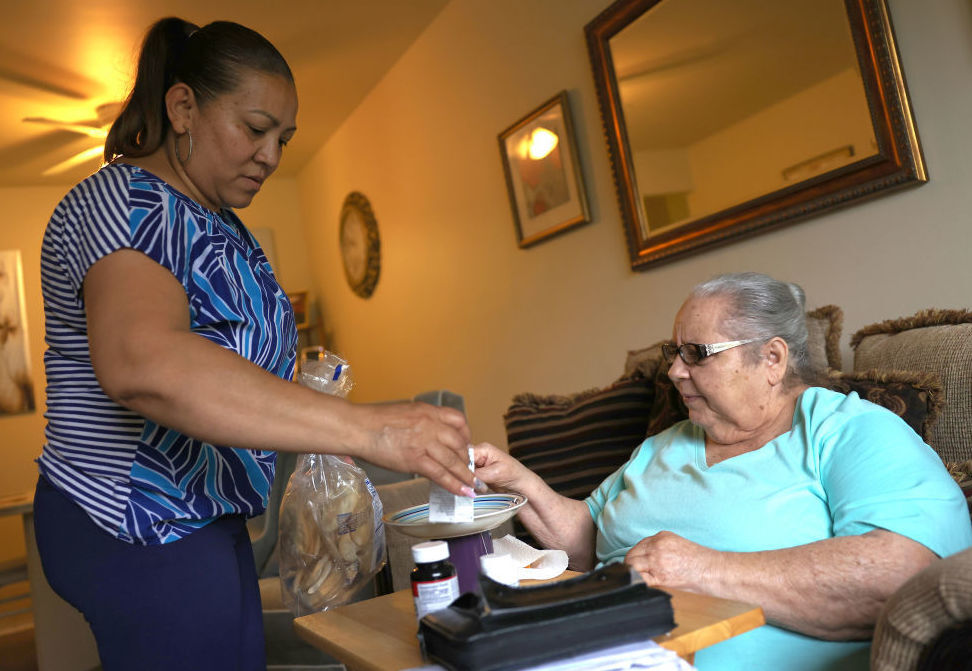
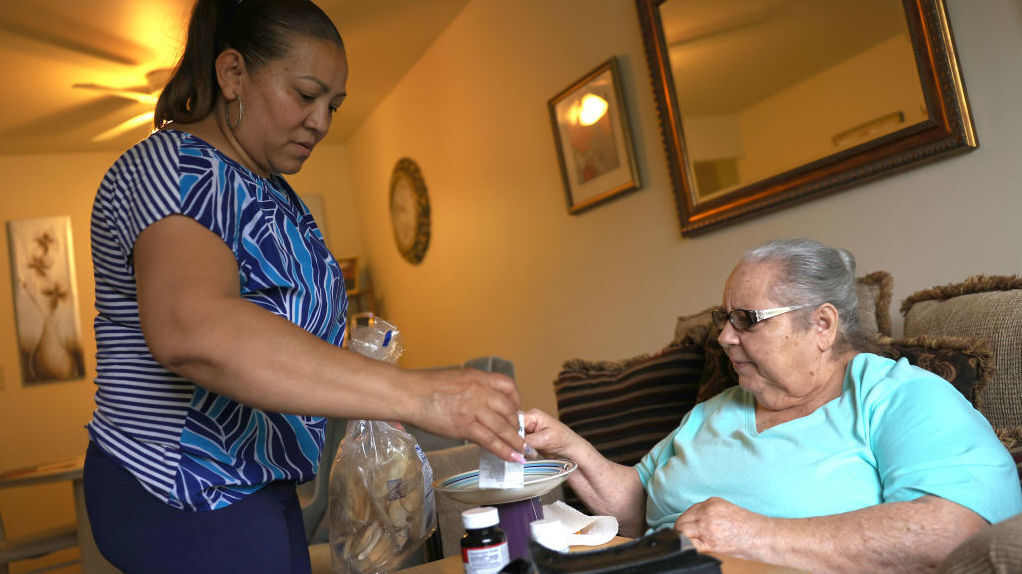
Expanded funds for in-home care can help seniors and disabled Americans stay in their homes. Here, Lidia Vilorio, a home health aide, gives her patient Martina Negron her medicine and crackers for her tea in May in Haverstraw, N.Y.

Michael M. Santiago/Getty Images


hide caption

toggle caption

Michael M. Santiago/Getty Images


Expanded funds for in-home care can help seniors and disabled Americans stay in their homes. Here, Lidia Vilorio, a home health aide, gives her patient Martina Negron her medicine and crackers for her tea in May in Haverstraw, N.Y.

Michael M. Santiago/Getty Images

For older people and people with disabilities, solving everyday practical problems can be the difference between being able to live at home or being forced to move to an institution. Sometimes people need help getting dressed or making meals. Sometimes they need help managing medications or shopping for groceries.

Originally, these things weren’t paid for by Medicaid, the federal health care program that many low-income and disabled Americans rely on. In recent years, the program has worked to expand coverage of home-based care but it’s still optional for states. Some states have adopted it widely, while in others, more care still happens in nursing homes and other institutions.

In April, the Biden administration rolled out funding from the American Rescue Plan to help states boost these services. And Thursday, the federal Department of Health and Human Services unveiled every state’s plan for how they’ll use the funds. An estimated $12.7 billion dollars in federal matching funds are available to “encourage states to expand home and community-based services and strengthen their programs,” according to an agency press release.

“More and more people are saying, if I need care, I’d like it to be done at home or here in my community versus an institution or a hospital or a nursing home,” says Health Secretary Xavier Becerra. “In the 21st century, we’re moving closer to a care model that’s based on giving people services in their home.”

Becerra adds that his own father spent his last few months in hospice at home. “When he passed, he was in my home, he was surrounded by family,” he says.

Medicaid recently surpassed 80 million beneficiaries — the most ever since the program was created in the 1960s. It is the primary provider of long-term care services for older people, since these are not covered by Medicare or private insurance.

Read More

How the US Army’s holistic health and fitness program will prevent injuries

How the US Army’s holistic health and fitness program will prevent injuries

It appears the era of “a couple of Motrin should do the trick” could be nearing its end in the Army. 

“My sergeants major right now, they hurt. Their bodies hurt,” Col. Phillip Kiniery, the commander of the 2nd Brigade Combat Team, 82nd Airborne Division, told Task & Purpose last week. “I need to make sure that the next group of leaders and senior leaders in the Army don’t feel like I feel physically. That they’re healthy … I wish we thought this way when we were going up.” 

The 4,500-soldier brigade is part of an effort to address injuries early and give soldiers more access to physical and occupational therapy through the Army’s holistic health and fitness program, which was announced in 2017 and officially put into Army policy last year. It focuses on total wellness, not just physical fitness, and urges mental and spiritual wellbeing, getting enough rest, eating well, and, more simply, just taking care of yourself. 

Referred to internally as H2F, the holistic health and fitness program encourages soldiers to take better care of their minds and bodies, not simply push through the pain after an injury, and emphasizes learning how to physically train properly. And at least one brigade commander is hoping that with that kind of change, the next generation of Army leaders won’t have the same kinds of aches and pains as, you know, all of you do. But to do that will require a certain level of humility from leaders. 

This is the Army’s plan to stop physically breaking so many of its soldiers
Paratroopers assigned to 2nd Brigade Combat Team, 82nd Airborne Division, utilize the physical training strength and conditioning coaches at the Falcon Holistic Health and Fitness Center (H2F) on October, 18, 2021 at Fort Bragg, North Carolina. (U.S. Army/Staff Sgt. Andrew Mallett)

“That’s what I’m fighting every day: ‘We’re the 2nd Brigade, 82nd, we’re going to jump into combat anywhere in the world, we’re the 82nd Airborne Division,’” Kiniery said. “Like hey sergeant, I got it. You can kill anything, you can jump out of every aircraft, but just stop and listen to this strength coach because you’re doing it wrong.” 

While the program could bring positive changes to soldiers everywhere, it will likely be years before it’s implemented Army-wide. There are currently 28 Army brigades — located at Fort Bragg, Fort Drum, Fort Polk, Fort Bliss, and Joint Base Lewis McChord — who have started implementing the holistic health and fitness program.

Read More

Opinion | Health Care Employment Is Rising. Is That a Good Thing?

Opinion | Health Care Employment Is Rising. Is That a Good Thing?

The biggest success story in the table is No. 2, Minnesota’s Olmsted County, where the Mayo Clinic in Rochester draws patients from across the upper Midwest, as well as elsewhere in the United States and abroad. Mayo has become even more important to the city in recent years because IBM has reduced jobs there at what was once one of its bigger computer factories. “It is a true blessing to have a world-renowned health care institution based in our county,” says John Wade, the president of Rochester Area Economic Development Inc.

Every county that is dependent on the health care industry must decide whether to double down on its specialty or to diversify so it doesn’t have all its economic eggs in one basket. Olmsted County is open to all kinds of employers, but it’s emphasizing health care, says Patrick Seeb, the executive director of Destination Medical Center, which, despite its name, is not a hospital but an economic development agency responsible for doling out infrastructure funds from the State of Minnesota.

Seeb is trying to get people to call Rochester America’s Med City. Google and Epic Systems have opened offices there to work with Mayo on, respectively, data mining and electronic medical records, he says. And now other companies are arriving because of Google and Epic. “It’s concentric circles,” he says.

The third county on the list is a less happy story. Kentucky’s Breathitt County is in a part of Appalachia that has suffered from declining employment, dwindling population and poor health. “Health care is one of our biggest employers,” says Sue Clair, who has a real estate development company in the county seat, Jackson. “We don’t have any other kind of employment but that.” A 40,000-square-foot industrial building was put up more than 20 years ago with public funds but has never attracted a commercial tenant. “Right now it has the Breathitt County Water District in it,” she says.

Breathitt County is not alone on the list in being hard-pressed. Three of the top 10 counties are in eastern Kentucky, and another, Cumberland, is in south-central Kentucky, all of which are struggling economically. That’s no coincidence. When the local economy falters, total employment dwindles, and the need for health care services increases, both of which push counties upward on the list. Kentucky has the nation’s third-highest mortality rate, after West Virginia and Mississippi, according to the National Center

Read More

Montana Tribes Want to Stop Jailing People for Suicide Attempts but Lack a Safer Alternative | Healthiest Communities Health News

Montana Tribes Want to Stop Jailing People for Suicide Attempts but Lack a Safer Alternative | Healthiest Communities Health News

POPLAR, Mont. — When Maria Vega was a senior in high school in 2015, she found the body of one of her closest friends, who had died by suicide. A few days later, devastated by the loss, Vega tried to take her own life.

After the attempt failed, she was arrested and taken to juvenile detention in Poplar, a remote town on the Missouri River a short drive from the North Dakota oil fields. She was put in a cell and kept under observation for several days until a mental health specialist was available to see her. Her only interaction was with the woman who brought food to her cell.

“I remember asking her if I could have a hug and she told me, ‘I’m sorry, I can’t do that,’” Vega recalled. “That was honestly one of the hardest things I ever went through in my life. I felt like I was being punished for being sad.”

Jailing people because of a mental health issue is illegal in Montana and every other state except New Hampshire. But Vega is a member of the Fort Peck Assiniboine and Sioux Tribes, a sovereign nation with its own laws. An 11-year-old tribal policy allows law enforcement to put members who threaten or attempt suicide in jail or juvenile detention to prevent another attempt.

Maria Vega, a member of Montana’s Fort Peck Assiniboine and Sioux Tribes, was jailed in 2015 after a suicide attempt. Vega is now part of a group of tribal members, academics and policy experts proposing alternatives to the policy of jailing people who try to kill themselves. The policy was created in 2010 because of a lack of mental health resources on the reservation. (Sara Reardon for KHN)

Maria Vega, a member of Montana’s Fort Peck Assiniboine and Sioux Tribes, was jailed in 2015 after a suicide attempt. Vega is now part of a group of tribal members, academics and policy experts proposing alternatives to the policy of jailing people who try to kill themselves. The policy was created in 2010 because of a lack of mental health resources on the reservation. (Sara Reardon/KHN)

Fort Peck’s tribal leaders say they approved the policy out of necessity because there were no mental health facilities equipped for short-term housing of people in mental crisis.

The COVID pandemic has only exacerbated the crisis. In 2020, the tribes filed a record 62 aggravated disorderly conduct charges, the criminal charge they created in 2010 to allow law enforcement to book people they deemed a risk to themselves or others.

Stacie FourStar, chief judge of the Fort Peck Tribal Court, said this year has been even worse: The tribe is filing two to four charges per week. The policy has swept up people — particularly adolescents — with no criminal records and no experience

Read More

Lecture highlights need for compassion in health care

Lecture highlights need for compassion in health care

A few years ago, Dr. Trzeciak was facing burnout as a health care provider and knew something needed to change.

As a person who loves research, he began to dig into related literature and studies that focused on combating burnout in providers. In medical school, he said, he was taught that caring too much and having too much compassion could cause a provider burnout more quickly. What he found in studies, however, painted a different picture.

“What the literature shows is that there is an association with compassion and burnout – but it’s inverse. If there’s high compassion, there’s low burnout. Why? Well, we don’t know for sure but I have my hypothesis,” Dr. Trzeciak said. “Because when you connect with people through compassion, and have a relationship that flows from that, you get the fulfilling part. If you don’t have that then all you have is a really stressful job.”

Key to Resilience is Relationships

He tested his hypothesis on himself, as a study subject of one and found that when he leaned into caring more rather than detaching, his feelings of burnout began to lift. It wasn’t just about connecting with and showing compassion to patients and families, but to everyone he worked with and interacted with—professionally and personally. He believes this method can work not only within health care but in every walk of life.

He challenged everyone who is feeling the effects of burnout to give his method a chance, not just because it has worked for him and helped change his life, but because it is backed by science.

He highlighted a Harvard University study that tracked students at the university and Boston-area teenagers throughout their lives and found the best predictor of good health and well-being into your 80’s is your midlife quality of relationships. Dr. Trzeciak said this and many other studies show that the key to resilience is relationships.

“That’s why it is vitally important in our health systems, in our medical schools, everywhere – at the shopping mall, at the grocery store – that we take good care of each other,” Dr. Trzeciak said. “You don’t have to be a health care provider to feel burnout, especially in 2021.”

Compassion in Health Care

Compassionate and caring environments not only help team members face less burnout, but also help patients see better outcomes.

During his lecture, Dr. Trzeciak discussed many studies pointing

Read More